Flaps podcast

Flaps Podcast

Flaps Podcast

I must confess – I am a bit of a podcast addict. I subscribe to all sorts of podcasts including comedy, short & long audio-stories, plays & drama, science fiction, and news. Unfortunately, good aviation audio podcasts seem to be few and far between, but one of my favourites is Flaps Podcast.

I like it because each issue is reasonably short – about 30 minutes long – and always leaves you wanting to hear more at the end. The downside is that some episodes lately seem to be very UK-centric, although earlier issues (for which they won Sony and New York Radio podcast awards) are much more general in their coverage and so overall more interesting. Every episode includes the ‘Pablo Mason Minute’ in fact usually about 3-4 times that long – where Pablo, an ex-RAF jet pilot and Squadron Leader recounts some specific flying experience, often quite hilariously.

One episode in September 2011, and its companion ‘Flaps Extended‘, was particularly interesting – they covered an interview (in both short and extended form) with Manuel Queiroz, who flew an RV-6 round the world. He was quite a low time pilot until he did the flight – an inspiration to us all. Click here for Manuel’s website ‘Chasing the Morning Sun‘, which has all the details of his flight.

There is an Australian aviation podcast called Plane Crazy Down Under but most episodes are well over an hour – sometimes over two hours – and are just too long for me. I’m usually ready to switch off after 40 minutes. If they broke up the episodes into shorter lengths and published them more often, I think that would suit people better. And maybe if they included an interview with Foxbat Australia along with all their other aircraft manufacturer/importer segments, it would be nice…….

Plane Crazy Down Under recently completed the DVD of the recent Tyabb Airshow (see my earlier blog post here) which is now available from Peninsula Aero Club by calling 03 5977 4406 with your credit card number.

Do you know any good aviation podcasts – or blogs?

The myth of the downwind turn – again

Here’s one which will always stir up some discussion – “there’s no such thing as a stall caused by turning downwind”.

It is common among pilots, even experienced pilots (and even the UK’s CAA and USA’s NTSB believe it or not) to refer to accidents caused by a downwind turn and the ‘increasing tailwind component’ in such turns.

It goes like this: the aircraft takes off into 15 knot head wind and makes a 180-degree turn downwind. If it turns quickly, the 15 knot headwind has ‘suddenly’ turned into a 15 knot tailwind, a difference of 30 knots, so the aircraft has to be accelerated to maintain flying speed or it will stall as it turns.

In reality this is complete rubbish and totally ignores the fundamental fact that the aircraft flying speed is a function of its speed through the air, not of its ground speed.

Better aviation minds than mine have written about this subject and explained the physics in depth, so I’m not aiming to repeat it all here. Enough to say that the aircraft is moving in its medium, like a boat on a river or even a passenger on a train. If you walk up and down inside a train, you don’t notice any acceleration or deceleration – because there isn’t any. It’s the same with an aircraft in the air.

If there are any demons in turning downwind, they are the same as for any other turn: reduced lift due to bank angle, reduced airspeed due to the pilot inadvertently pulling back on the stick, etc.

Here’s a link to a short amusing article by Peter Garrison in an old ‘Flying’ magazine – ‘The last word on downwind turns – really’

Here’s an article in Australian Flying magazine which explains it all very clearly: ‘Dragons of the downwind turn’

To prove it for yourself, next time you go flying, look for a bit of wind – maybe 20 knots or so aloft. To re-assure yourself – just in case anything goes wrong – climb up to about 3,000 feet and point yourself into the wind, flying straight & level. Then execute a reasonably rapid – maybe 30 degree bank angle – 180 degree turn down wind. Do it level with the slip ball in the middle and watch the Airspeed Indicator. Stays steady OK? Now repeat and watch the ground speed on the GPS – increases OK? Feel any acceleration?

World Cup celebration – Foxbat Brazilian style

Brazil A22LS Amphibian

Brazil A22LS Amphibian

To celebrate the start of the world cup in Brazil, I thought you’d like to see some examples of the A22 Foxbat, Brazilian style.

There are some very attractive and eye-catching paint jobs and some interesting instrument panels. And one photo I would definitely advise not trying at home…

Have a look in the photo gallery at the bottom right side of this blog for further pictures.

Many thanks to my colleague Wander Azevedo of FLY Ultraleves, Aeroprakt distributor for Brazil, based in Goiania, south west of Brasilia.

Here’s a link to his website, if you’re interested in a Foxbat in Brazil: Ultraleves Brazil

Ido Segev flies the Foxbat

Ido SegevIdo Segev is a world champion aerobatics pilot – of large, freestyle RC model aircraft. In his spare time, he’s also a flying instructor for full scale aircraft, based at Moorabbin Airport, Melbourne, and a multi-copter pilot for a video and photographic organisation.

As you can see from his video channel on YouTube – Ido Segev YouTube Videos – he’s a very accomplished pilot!

In our latest video, he talks about flying the Foxbat: Ido Segev Flies the Foxbat

Thanks to Mike Rudd for the video production. Mike Rudd YouTube Channel

e-Go aeroplane

e-Go prototype

e-Go prototype

Now here’s one of my favourite up and coming single seat ultralights – the e-Go aeroplane.

Contrary to the suggestion in its name, the e-Go is not battery powered (yet). In fact propulsion unit is a 30 hp rotary (Wankel) engine adapted for the aircraft from its original use in large drones.

Performance figures for the single seat, very light weight (115 kgs empty) aircraft are quite amazing – cruise around 100 knots, slowest flight speed (canards don’t stall as such) around 35 knots, take-off and landing distances around 150 metres. Typical fuel burn is around 6.5 – 7.0 litres/hour, giving about a 3 hour duration with reserve.

The aircraft is not yet in production and is still undergoing extensive testing in its home country – the UK. First customer deliveries are expected to be in early 2015. However, at an asking price from about UK£50,000 (that’s about A$90,000 plus shipping and taxes at today’s rates) I can’t see high volume sales in Australia. And there’s also the problem of registration in Australia – currently (unlike USA and Europe/UK) there is no category under which this factory-built midget speedster can be registered. That’s a shame, as even given the high price, there are undoubtedly well heeled buyers out there who would have one…

Here’s a link to the e-GO website: e-Go aeroplane

Let me know your thoughts. Are you interested? Reactions to price? Lack of Australian movement towards ‘deregulation’ of single seat ultralights as per USA and Europe?

And here are some links to earlier blog posts I made about single seat light aircraft:

Single seat ultralights – the Sirocco NG

More single seat ultralights – the Aerolite 103

What does your plane smell like?

I was just taking off the other day when I caught an unmistakable whiff of fuel. In the event, the smell disappeared quickly and turned out to be the dregs in my fuel tester cup, which I hadn’t properly emptied. I keep the tester in the wing root storage pocket of my Foxbat just above and to the left of my nose.

This brief experience set me to thinking about aircraft smells generally, and how sometimes it’s all too easy to dismiss an unusual odour – however faint – as nothing worth worrying about. But here are a couple of true stories about how you should listen to your nose – if you know what I mean.

First – coolant. A few years ago, I was flying an aircraft home just after maintenance. Like the Foxbat and many other Light Sport Aircraft, this one was/is powered by the Rotax 912 liquid cooled engine.

Burned coolant hose

Burned coolant hose

About 15 minutes into my planned 20 minute flight, I thought I could smell coolant – that peculiar metallic hot water and anti-freeze smell. The cylinder head and coolant temperatures were steady, as was the oil temperature. But the smell wasn’t going away, even if it wasn’t getting any worse. Luckily my destination was soon within gliding distance, so I throttled back, made a radio call and landed without completing the usual circuit.

It turned out the engineer had moved one of the coolant radiator hoses during maintenance. When the cowlings were replaced, the hose had made a slight contact with the nearby exhaust, enough to burn a tiny hole, through which coolant was dripping onto the exhaust. I should have picked up this proximity during my pre-flight but didn’t. In fact with the top cowling off, the hose was a millimetre or two clear of the exhaust underneath it. But replacing the cowling, to which the coolant radiator was fixed, was enough to move the hose slightly and enable contact with the exhaust. The manufacturer subsequently issued a service bulletin requiring a specific clearance between coolant hose and exhaust. They have now re-designed the installation to avoid the problem.

Next – exhaust. Many years ago, I was flying another Rotax-powered aircraft, fitted with flexible exhaust tubes connecting the manifolds to the muffler. In flight, I thought I could smell exhaust fumes. Being an unfamiliar aircraft, I wasn’t sure if this was a trait of the aircraft or a real problem

Burned oil filter 01

Burned oil filter

However, I opened the air vents in the doors and decided to make an unplanned landing a few minutes later at the nearest airstrip. Sure enough, one of the exhaust tubes had slightly fractured. Most worrying – the hole pointed the escaping exhaust gases directly at the oil filter canister and it was only a matter of time before it would have burned through. If oil had escaped onto the exhaust in these circumstances, I really don’t want to think about the possible outcomes.

So get to know your aircraft’s typical smells and whether it’s the unusual smell of exhaust, fuel, coolant, oil or brake linings – listen to your nose and take immediate action!

Anyone else had a similar experience?

6 tips for aerial photography

Mike Rudd I first met Mike Rudd a few years ago when he was visiting my base airfield to test fly a couple of aircraft. At the time he was  the owner of a flexwing microlight (or trike, or powered hang glider). He was looking for a more conventional, 3-axis aircraft. Luckily for me, a Foxbat was on his shortlist.

Apart from being an experienced pilot, Mike is a video/photographer of some considerable talent and I was soon privileged to count him among Foxbat owners in Australia. More importantly, Mike has made many excellent videos about the Foxbat and taken literally hundreds of photos of them, some of which adorn the Foxbat Australia website – www.foxbat.com.au – and our magazine advertisements.

Mike has his own YouTube channel where you can see his work for yourself: https://www.youtube.com/user/mikerudd1948

Here, he gives a few tips for getting the best out of taking photos and videos from an aircraft:

GoPro1. Choose your photographic equipment carefully. For in-cabin work, the GoPro camera has become ubiquitous but high-end pocket cameras like the Sony RX100 Mk 2 Sony-RX100-IIare as good and in some cases better. For example, pocket cameras have a zoom feature and you can also stop the weird effects of shooting through the propeller without resorting to the neutral density filters needed for the GoPro.

2. Canon 5dFor air-to-air stills (and even video), a full sensor DSLR will give the best results. Mike uses a Canon 5D Mk3 with a stabilised 24-105mm lens. For shooting air-to-ground (where the ground stays fixed, unlike a subject aircraft), you can increase the telephoto lens to a 120-400mm.

3. Use a fairly slow shutter speed to get the propeller blurred but not invisible. By default, this also gives you a smaller aperture which helps with depth of field. If your camera has the facility, use auto-focus and continuous shooting as everything is in motion and some of the photos will inevitably be blurred. Make sure the white balance and ISO are set correctly – make some trial/test shots before the main shoot. If at all possible, shoot in RAW mode, enabling better image manipulation and editing.

4. A thorough briefing between the pilots and the photographer is absolutely essential. If you do not have a formation endorsement, the aircraft must remain at least 100 feet (around 30 metres) apart – about three wing spans for most light aircraft. You need to confirm the desired background, target altitude, and track in relation to the sun – ideally have the sun at ten or two o’clock to the subject aircraft, shining into the front of the cabin. Early morning and late afternoon make for better shadows and show the aircraft lines better.

Only the pilots should talk to each other. The photographer can tell ‘their’ pilot what they want and have it relayed to the subject pilot. Whether the subject aircraft flies straight & level and the photo ship moves around or vice versa doesn’t matter – as long as this is agreed before taking to the air. At all times, at least one of the pilots must be responsible for maintaining visual separation.

Be very very careful when operating high and low-wing aircraft together and absolutely avoid the low-wing aircraft flying above the high-wing aircraft where neither pilot can see the other.

Foxbat photo ship 01_edited-15. Choose your aircraft even more carefully than the photo equipment! High-wing aircraft are much better for aerial photography – particularly for taking pictures of the ground! Pictures will be much clearer through open air, rather than a perspex window, so look for an aircraft where the photographer’s window or door can be opened safely in flight. Or if certified to do so, even remove the door before you start. The aircraft should be safely manoeuvrable across a range of speeds and have plenty of room in the cabin for stowing cameras. The photographer also needs room to move around without interfering with the controls. For obvious reasons, the photographer’s safety belt should remain done up all the time and the camera must be attached to the photographer by a short strap!

6. Finally, back on the ground, you’ll want to edit and refine your pictures. This is where RAW format photos are really needed, as you have far more options for enhancement. Mike uses both Adobe Lightroom and Photoshop, aiming for 300dpi full-frame jpegs for printing and 72-96dpi for internet and website use.

A couple of reminders – you need a legal permit from an engineer to attach a camera to the outside of a plane. This applies to all aircraft whether GA, LSA or ultralight. Make sure your aircraft is certified for door-off or door-open operations if you plan this; on some aircraft stall speeds can increase dramatically with a door off or open. Safety is always your first responsibility – it’s better to shoot from a safe distance and crop when you are on the ground.

For a sample of Mike’s air-to-air pictures, have a look at our gallery – bottom right of this blog. And for an amazing video with aerial footage, have a look at this YouTube link: Foxbat landing on a ship at sea
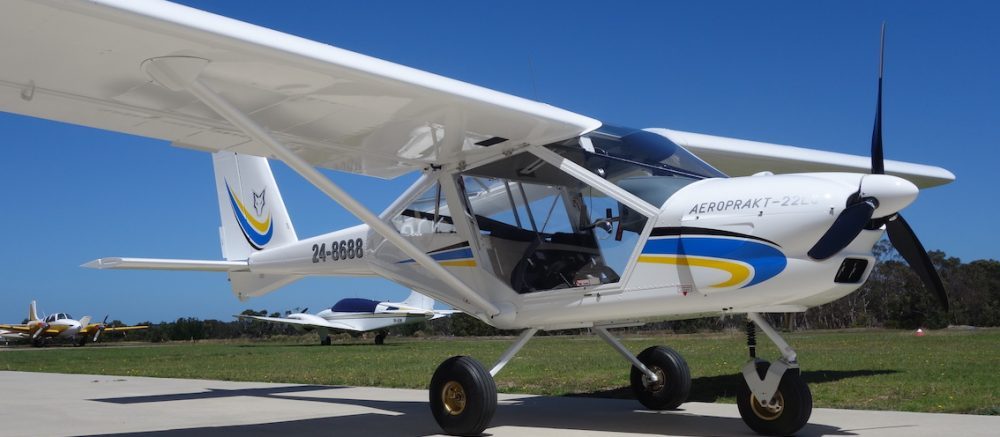
Foxbat as photo ship


Foxbat 7277 short strip landingWe recently set out to do some air-to-air and air-to-ground photography using my yellow Foxbat demonstrator as the photo ship. By ‘we’ I mean Mike Rudd – veteran professional videographer and photographer – in the right hand passenger seat and myself flying.

Normally, these shoots centre round the subject aircraft, on this occasion a Top Cub by Cubcrafters and another (red) Foxbat, which happened to belong to Mike. And indeed, we got some great pictures – have a look at the photo gallery to the bottom right of this blog to see some samples.

However, on this occasion Mike urged me to write something about one particular short sequence where, quite spontaneously and unplanned, we video’d his red Foxbat doing a very brief touch-and-go on a short, narrow and wet bush airstrip in the middle of nowhere. The video will appear shortly on YouTube (I’ll put up a link when it does) but meanwhile, here’s a preview of what we did.

After the air-to-air shots and some stills of the Top Cub landing and taking off, the pilot of the red Foxbat decided he’d emulate the Cub by landing on the same short strip – this impressed me because the Foxbat pilot was Stephen Buckle, Cubcrafters dealer for Australia. Who once owned a Foxbat of his own before drifting to the dark side….and Stephen’s passenger, Terry Walker, who owns a super little taildragger Kitfox, making them both familiar with the demands of short strips.

Stephen and I executed contra-direction circuits (‘patterns’ for our friends across the Pacific) and began parallel approaches to land. Except that Stephen was lined up on the runway and we were lined up about 50-60 metres to his left over some fairly tall trees. Now the Foxbat typically touches down in the high 30’s knots, so to get the footage, we had to slow down to much the same speed or we’d miss the brief touch and go-around.

Mike was busy with his camera, concentrating on his red Foxbat urging me to go ‘slower’ and ‘faster’, ‘higher’ and ‘lower’ to get the video he wanted. So there I am, sitting in the left seat, subject plane on the right, and lower than me, flying at about 35 knots….watching the tall trees coming up ahead of me.

It was during that sequence that once again it was emphasised to me what a great plane for photography the Foxbat is.

Controllable down to 30+ knots with full flap, I could see the subject plane all the time, even though it was on the opposite side to me, and Mike with his (large) camera in the passenger seat. It has an abundance of power – on the YouTube video you’ll hear the engine noise, not of the subject aircraft but of mine, so you’ll know when the power was on and off.

The only thing I regret is not having had a camera pointing straight out the front so you can see the trees and bush which close right up to the strip. When you think of all the variables and the process of shooting that short piece of video, there aren’t many aircraft short of a helicopter that could have handled it.

Look out for a future post on some thoughts about getting some good photos from your aircraft. And, of course, the link to the YouTube video of Mike’s red Foxbat and that tricky little bush strip.

PPL Medical

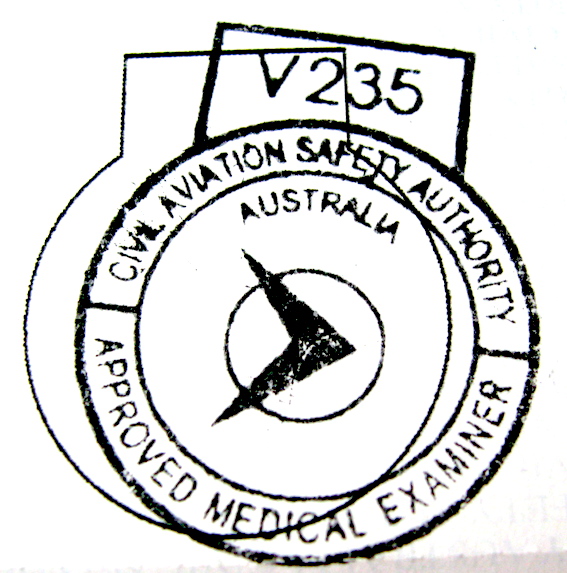
I just did my bi-annual medical forCASA DAME Stamp my PPL. These days, it seems this is the only time I get to see a doctor, so I treat it as my regular health check.

CASA has joined the digital age and the medical form is now filled in online by the doctor, as you answer the questions. All that stuff about how much alcohol I (shouldn’t) drink and how much exercise I (should) take. I wonder if anyone ever answers ‘yes’ to the question: “Are you a regular user of cocaine, LSD, amphetamines, marijuana or other regulated narcotics?”. It seems like an endless series of questions, about all aspects of your life, most of which you wouldn’t want to admit to even if you had the ailments/conditions they refer to. I suppose if you give an incorrect answer and then have a ‘mishap’ in an aeroplane, particularly if it is anything related to the wrong answer, they throw a book at you. And any aviation insurance you may have would probably be invalidated. Lucky for me, I’m a clean living boy with no skeletons in my cupboard.

Then after the form filling comes the physical bit. It never ceases to amaze me how even the simple things have been mechanised/computerised. I remember when your blood pressure was taken by the doctor pumping up a cuff on your arm, then slowly releasing the pressure and listening through a stethoscope for your heartbeat, noting the pressures. This time it was a gizmo with a little pump and sensor that did it all automatically and displayed the two pressures on the obligatory LCD screen. Headsets and bleeps for your hearing – my doctor used to stick his finger in one (of my) ears and whisper numbers near the other, asking me to repeat them….And talking of fingers, there’s the mandatory rubber glove treatment for us men ‘down there’.

So far, what’s good are my blood pressure, decreasing weight, and blood sugar levels. Not so good is my eyesight; by my next medical I may even have to consider glasses. Well, I suppose I should be grateful I got this far without them. Now, where was I?

Next are the ‘bloods’ – whatever happened to blood tests? And an ECG as I’m getting older and haven’t been to my GP in the last 2 years. These are not mandated by CASA, so the medical certificate has been issued and I can fly again for another two years.

Deep breath for my Bi-annual Flight Review – BFR – later this week. More of that anon.

Old aeroplanes – aren’t they wonderful?

ImageI have always loved old aeroplanes. I can remember as a small boy going along to air shows and being thrilled by the rumble of big radial engines and the spine-tingling noise of a 12-cylinder Merlin engine on a Spitfire. And the smooth sound of the ubiquitous Lycoming or Continental flat four. There’s just something about the smell, sound and look of an antique aircraft that pushes all my buttons – well, many of them, anyway!

A while back, I joined the Antique Aeroplane Association of Australia – AAAA – which is (strangely as its name suggests) an association for the owners and operators of older aircraft. They have a great website at: http://www.antique-aeroplane.com.au where you can find out all about old planes and how to join AAAA.

They categorise their aircraft in four ways – Antiques are those aircraft in production in or before 1945; Classics are from 1945-1955; Contemporary are 1956-1970; and Warbirds are what they say – aircraft of any age, ooperated by the military of any country. The AAAA has gatherings all over Australia and they have a current events list on their website. Of particular enjoyment each year are the various State & Territory ‘Toy Runs’ for collecting presents for disadvantaged children – check the AAAA website for details later in the year.

Meanwhile, I’ll soon be flying my own antique aeroplane, which is older than me but in much better condition! Watch this space…